
How to ask a farmer for permission
Found Ground Labs · October 2026 · Updated November 2026
Most arrowheads come from private farmland, and the only way onto it is a yes from the owner. Here is how to ask so that a yes comes easier, and how to keep it for years.
Find out who owns the field
The person farming a field is not always the owner. Many fields are rented. County property records are public, and most counties have an online map where you can click a parcel and see the owner's name and mailing address. Ask the owner. It doesn't hurt to let the farmer who works the ground know, too.
Pick your moment
Farmers are busiest at spring planting and fall harvest. That is the worst time to knock on a door or call. Better times to ask:
- Late summer, before harvest, so you are on the list when the crops come off.
- After harvest, once the work slows down.
- Winter, when there is more time to talk.
If you go in person, go in the daytime and not at mealtimes. Don't block a lane or a gate when you park. Keep it short and friendly.
Ask about one field, or a few, and say which ones. "The field along the creek behind your barn" is easier to say yes to than "all your land."
Say exactly what you will do
Most owners worry about the same things: ruts, trampled crops, open gates, trash, holes and someone getting hurt. Answer those before they are asked. Promise:
- On foot only. No vehicles in the field.
- No digging, no metal detectors, no tools. You pick up only what lies on top.
- Only after the crops are off and the ground is firm. Never in standing crops or mud.
- Gates left as you found them, and any trash picked up.
- A call or text before each visit if they want one, and parking wherever they say.
- Staying out during deer season, or on any dates they name.
Then keep every promise, every time.
Offer something back
- Show them what you find. Many owners like seeing what came off their land, and some have stories about points a parent or grandparent picked up.
- Settle who keeps what, up front. Some owners want to keep finds from their land. Agree on it before you start, not after you find something good.
- Ease their mind about injuries. Some owners worry about being blamed if you get hurt. Offering to sign a simple statement that they are not responsible can help.
- Paying for access is not expected, but some hunters offer it.
A sample letter
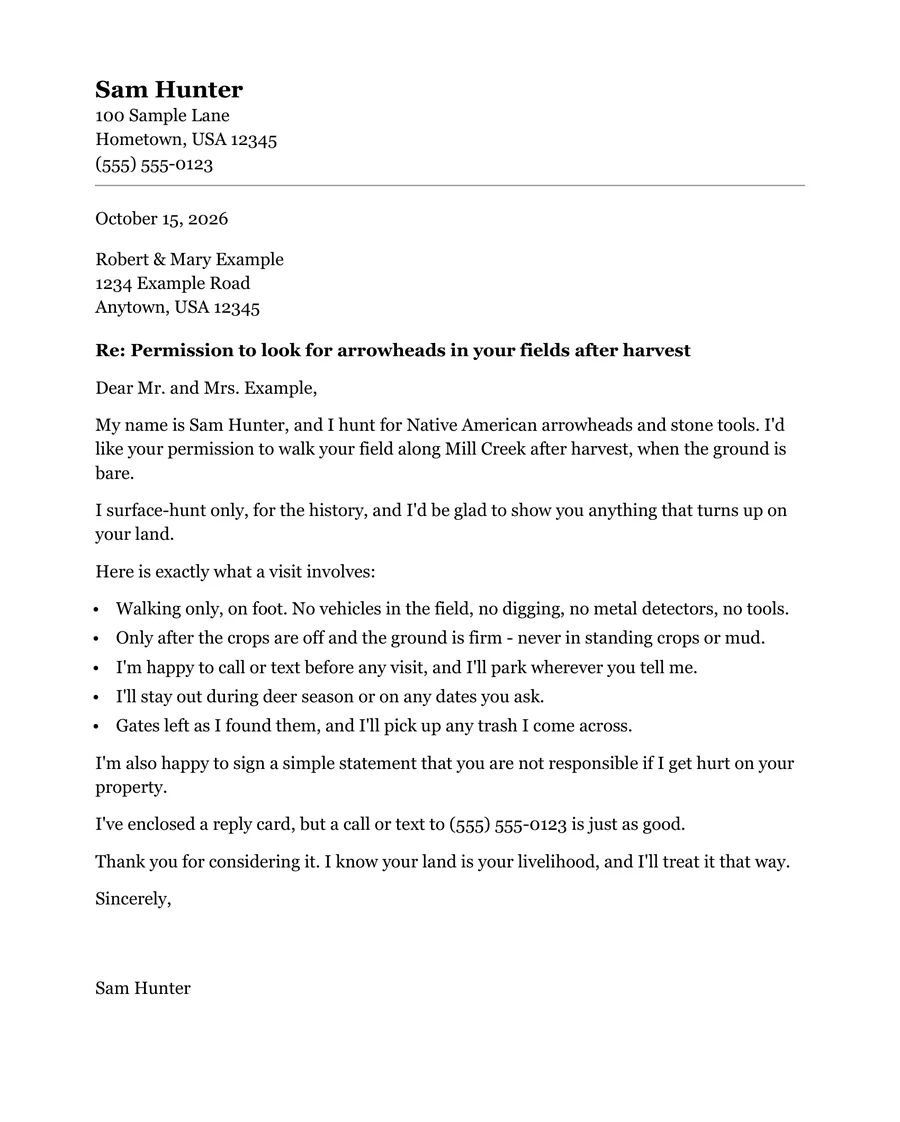
A letter works well. The owner can read it when there is time, it shows you are serious, and it lists your promises in writing. Here is one you can make your own:
Re: Permission to look for arrowheads in your fields after harvest
Dear [owner's name],
My name is [your name], and I hunt for Native American arrowheads and stone tools. I'd like your permission to walk [your field along the creek] after harvest, when the ground is bare.
I surface-hunt only, for the history, and I'd be glad to show you anything that turns up on your land.
Here is exactly what a visit involves:
- Walking only, on foot. No vehicles in the field, no digging, no metal detectors, no tools.
- Only after the crops are off and the ground is firm, never in standing crops or mud.
- I'm happy to call or text before any visit, and I'll park wherever you tell me.
- I'll stay out during deer season or on any dates you ask.
- Gates left as I found them, and I'll pick up any trash I come across.
I'm also happy to sign a simple statement that you are not responsible if I get hurt on your property.
I've enclosed a reply card, but a call or text to [your phone number] is just as good.
Thank you for considering it. I know your land is your livelihood, and I'll treat it that way.
Sincerely,
[Your name]
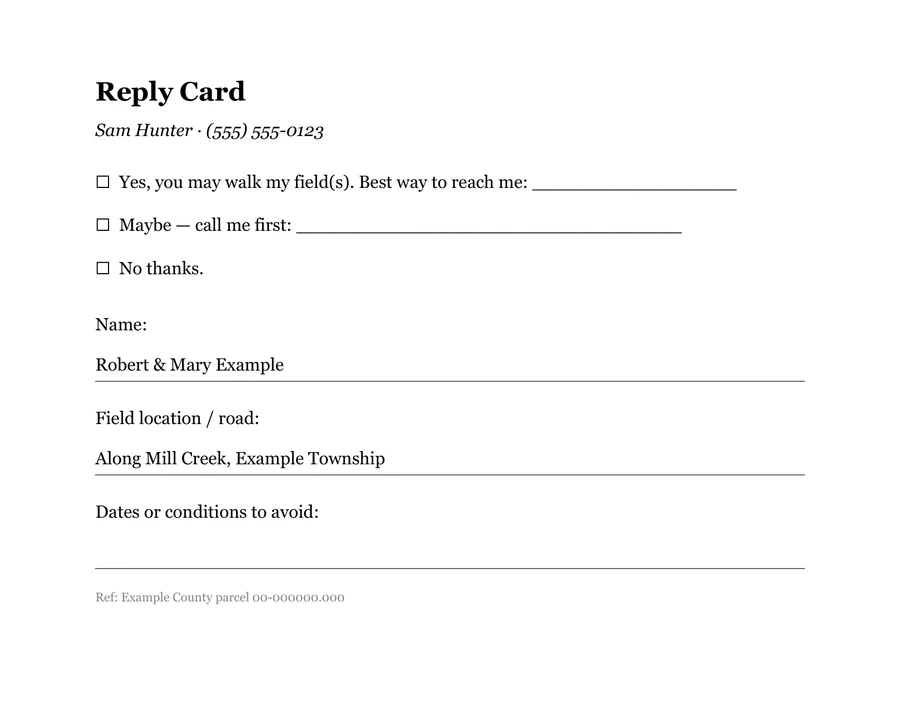
Put a stamped reply card in with it: yes, maybe, or no thanks, with a line for a phone number. A yes is far more likely when it only takes a check mark.
If the answer is no
Thank them and move on. A polite no today can turn into a yes in a few years, and a pushy ask can close the door for every hunter who comes after you. Never walk a field after a no, and don't assume an old yes still stands once the land changes hands.
Keeping a yes
- Send a thank-you note.
- Check in before each visit if that is what they asked.
- A card at the holidays, or a photo of your best find from their field, goes a long way.
- Tell them if you see a problem: a downed fence, an open gate, dumped trash.
A good name with one farmer is often how you get the next field.
Let First Rise do the paperwork
First Rise looks up who owns each field from the county's public records and writes a letter like this one for you, with the owner's name and mailing address already filled in. It prints a reply card for each owner, plus mailing labels and return-address labels, and keeps track of who you have written to. Make the letter your own, add an offer to pay for access if you like, then sign it and mail it.
Printing letters is part of First Rise Pro ($34.99 a year) and starts as soon as you subscribe - you can subscribe during the 7-day free trial. Before then, you can preview your letters exactly as they will print.
Permission is not permission to dig
A yes means walking and picking up what lies on top. Leave mounds and earthworks alone: they are graves and sacred places. If you find bones, stop, leave them where they are and call the county sheriff or coroner right away. Collecting on public land is against the law in Ohio, whoever you ask. Rules differ from place to place, so check before you go.