
When to hunt after rain
Found Ground Labs · October 2026
Two hunters can walk the same field a week apart and have very different days. Most of the difference is the weather. Here is what makes a good day for surface hunting, and how First Rise's Arrowhead Index turns it into a number for the morning and the afternoon.
Why rain matters
On a worked field, the top is loose soil. A good rain washes the fine dirt away and leaves stones sitting on top. A point that was a dusty brown lump yesterday is washed clean today. Wet flint also shows its true color and a little shine, so it stands out from the soil around it.
Heavy rain does more. It moves soil, cuts small gullies and uncovers stones that were just under the surface. A week with an inch or two of rain can make a picked-over field feel new again.
Watch for stones sitting on little pedestals of soil. The rain washed the dirt away around them, and the stone kept the dirt underneath it dry.
The day after
The best time is usually soon after the rain stops. The flint is clean, the ground is still damp, and the top has not dried to a crust. In a downpour or with thunder about, wait: you can't see well, and walking a soaked field leaves deep tracks the farmer won't thank you for. If your boots sink and pick up mud, come back later.
As the days pass, the surface dries and a film of dust settles over everything. Flint that glinted on the first day blends in by the fourth.
Clouds beat sunshine
A gray sky gives flat, even light. There is no glare off wet ground, no deep shadows, and every color shows. Bright sun does the opposite: glare, hard shadows, and a surface that dries fast.
That is why a cloudy morning can be a great morning even if the afternoon clears. On a sunny day, go early or late, and walk with the sun at your back. It cuts the glare and makes flint much easier to pick out.
Freshly worked ground
Most fields can't be walked until the crop is off. After harvest, a crop field that has been disked or worked up shows the most bare dirt, and it gives the most after its first good rain. Freshly worked ground often looks rough and lumpy. A rain or two settles it and washes the stones clean.
No-till fields keep their stubble, so less ground shows. But a hard rain still moves soil on them, so they are worth a look after one, especially where water runs: low spots, slopes, the edges of grassed waterways. Anything that causes erosion helps.
Frost and frozen ground
Cold doesn't stop you: a frozen field is still huntable. Over months and years, freezing and thawing break up the ground and help erosion bring stones to the surface. One cold night won't uncover anything new, but a freeze followed by a thaw is still a good day: the melting frost wets the ground, so everything glistens like it just rained.
Snow is different. Even a thin cover hides the ground, so that is a day to stay home. Bitter cold, with a high in the teens, makes for hard ground and short days.
How the Arrowhead Index scores a day
First Rise gives each field an Arrowhead Index from 1 to 10. It uses the rain measured at that field by weather radar and rain gauges, not just a forecast, along with the sky, the temperature and snow on the ground. Here is what counts:
- Rain this week. The biggest part. A fifth of an inch helps a little, an inch helps a lot, and two inches or more scores highest.
- Moisture in the last two days. Damp ground scores well. Soaked, muddy ground scores a little lower.
- Cool weather. Under 60 degrees, a field that got half an inch or more in the last three days still counts as damp.
- Rain falling. Steady rain under cloud, with no thunder and above freezing, scores a 10: wet flint shows best.
- The day after a soaking rain. At least a quarter inch in the last two days, and the rain has stopped: a bonus, because the flint is washed clean and the mud has not dried hard.
- The sky. Overcast adds points and mostly cloudy adds a little. Partly cloudy is neutral. Mostly sunny and sunny take points away for glare and drying.
- Freeze and thaw. A freeze overnight followed by a thaw adds points to the half of the day the thaw comes in, usually the morning: the melting frost wets the ground like a light rain. A day that stays well below freezing costs some.
- Snow on the ground. There is no score: it is a day to stay home.
- Recent rain sets a floor. If it has rained at all in the last three days, the index is at least 2.
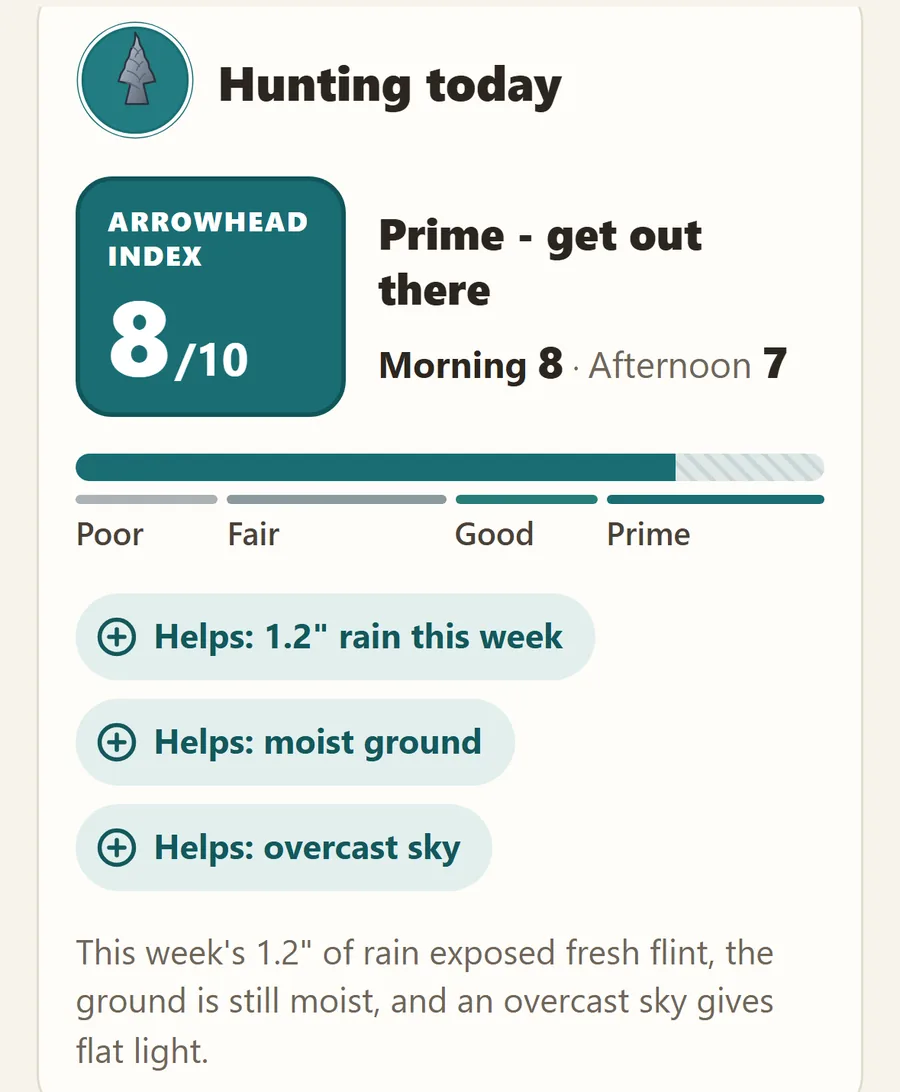
Morning and afternoon
The sky can change by lunch, so the index scores the morning and the afternoon on their own, each with its own cloud cover. For the half of the day you are in, it uses the latest report from the nearest weather station when there is a fresh one, so clouds overhead count even if the forecast called for sun.
It also says what helps and what hurts in plain words, such as rain this week that exposed fresh flint, or bright sun that means glare.
A high number doesn't promise finds, and a low one doesn't mean stay home. It is a quick way to choose between days, and between the morning and the afternoon.
Before you go
- Permission first, every time.
- Watch the sky. Leave the field when a storm or lightning moves in. First Rise shows rain radar, storm warnings and nearby lightning on the map.
- Surface only. No digging, and leave mounds and earthworks alone: they are graves and sacred places.
- If you find bones, stop, leave them where they are and call the county sheriff or coroner right away.